Synthesis and application of  -bromo-perfluoroalkylvinyl ethers -bromo-perfluoroalkylvinyl ethers
V.M.Andrushin, V.V.Drozdov
Report V. Study of physical and mechanical properties of
copolymers of fluoroolefins with -bromoperfluoroalkylvinyl
ethers.
1. Introduction
In report IV (1) the routes to modify fluoroplasts by copolymerization of tetrafluoroethylene (TFE)
and vinilydene fluoride (VDF) with bromo-perfluoroalkylvinyl ethers (BrAVE) of the general formula
of Br(CF2)nOCF=CF2 where n=2 ( BrAVE-2) and n=4 (BrAVE-4) have been described.
The introduction of fluoroalkylvinyl ethers to copolymerization with olefins is known to improve
processibility of the copolymers, increases their resistance to low temperatures and their stability
in aggressive chemical media.
They are used as the second and third copolymers (2-4)
In particular, a fluoroelastomer based on triple TFE copolymer, perfluoromethylvinyl ether and substituted
perfluoroalkylvinyl ether of the general formula of CF2=CFORfX is known.
Bromine-containing molecules allow to synthesize new types of fluoroplasts possessing hydrophilic,
conductivity, improved solubility and better processibility. Thus, for example, the introduction
of bromotrifluoroethylene to the composition of polytetrafluoroethylene increases amphoterism of
the copolymer and reduces its melting temperature (5).
Bromine-containing monomers, for example
1-bromo-2,2-difluoroethylene, have found wide application in processes of copolymerization with TFE,
VDF, hexafluoropropylene and other fluoroolefins to produce fluoroelastomers and general rubber goods
based on rubbers (6-9). In this case bromine atoms are convenient active centers to form space-network
structures (10-16). There are known many polymer compositions of radical solidification based on
bromated and iodinated fluoroelastomers (17-21).
It was planned to produce new fluoroplasts and
fluoroelastomers with a set of performance characteristics peculiar to copolymers based both on perfluoroalkylvinyl
ethers and on bromine-containing fluoromonomers using BrAVE monomers as modifiers of fluoropolymers
in reactions of copolymerization with fluoroolefins.
In the present paper we state the results
of the determination of general physical and mechanical characteristics of copolymers of BrAVE with
the most widespread fluoromonomers, TFE and VDF, and their resistance in different aggressive chemical
media.
2.Test procedure
Physical and mechanical characteristics of materials were determined on the basis of the results of tensile
tests carried out on a test machine of 2055 P-05 type of "TochPribor" (c. Ivanovo, Russia) made.
Test samples were two-sided scoops manufactured by blanking from films with a special knife. The
machine is equipped with a hermetic autoclave of a special design with controllable electrical heating
to provide testing the samples in different aggressive chemical media.
Based on the tensile
test results the following physical and mechanical characteristics were calculated:
- breaking stress, MPa
 , MPa , MPa
where Pp is the load at the sample destruction, N
Fo is the starting surface of
the sample cross-section, cm;
- modulus of elasticity, MPa
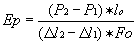 , MPa , MPa
where P1,P2 are the loads chosen at the initial linear part
of the tensile diagram, N;
 l1,l2 - are the sample elongation at the loads of P1,P2 respectively, cm; l1,l2 - are the sample elongation at the loads of P1,P2 respectively, cm;
lo- is the length of the sample test part, cm;
- percent elongation
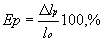
where lp is the sample elongation at rupture, cm;
- percentage change of the breaking stress
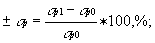
where  p1 is the breaking stress in a medium, MPa; p1 is the breaking stress in a medium, MPa;
p2
is the breaking stress in air, MPa;
- percentage of the modulus of elasticity
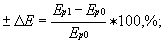
where Ep1 is the modulus of elasticity in a medium, MPa;
Epo is the modulus of elasticity in air, MPa
- change of percent elongation
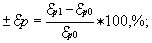
where  p1 is
the percent elongation in a medium, %; p1 is
the percent elongation in a medium, %;
po is the percent elongation in air,%.
To determine chemical
resistance of the copolymers, samples were subjected to aging for 7 days in 20% solutions of sulfuric
acid and caustic soda at a temperature of 90oC and then their physical and mechanical
properties were determined at tensile at 20oC.
2. Study of physical and mechanical characteristics of copolymers
of TFE.
The fluoroplast of F-10 type widely used for making flexible pipelines, gasket materials etc. was used
as the comparison standard.
The comparison of modificating affect of BrAVE monomer and other
fluoromonomers such as -fluorosulfuryl-perfluoroalkylvinyl ether (FS-141), perfluoroallylvinyl ether , perfluoroallylalkylvinyl
diether was of an undoubted interest also. Some results of the conducted experiments are given in
Table1.
The study has shown that the strength characteristics and modulus of elasticity considerably
increase after treatment in alkali for almost all types of copolymers of TFE tested. Some reduction
in the modulus of elasticity of copolymers with FS-141 was observed in tests in sulfuric acid against
a background of some increase in the strength parameters. Deformation characteristics of the all
copolymers of FS-141 tested ( with different content of comonomer) are reduced in aggressive media
and to a greater degree in aging in alkali.
As regards to BrAVE monomers, all their physical
and mechanical parameters increase both in acid and in alkali media and the modulus of elasticity
and breaking stress increase to the greatest extent.
It is seen from Table 1 that effectiveness
of BrAVE monomers goes down with the chain length growth. The increase in the strength characteristics
of copolymers based on BrAVE after their aging both in acid and in alkali is explained by additional
cross-linking of the copolymer which takes place at the contact of the bromine-containing copolymer
with an aggressive medium.
|